


 Mango ( आम )
 Jackfruit ( कटहल )
 Lemon ( नींबू )
 Chilli ( मिर्च )
 Gooseberry ( आंवला )
 Garlic ( लहसुन )
 Ginger ( अदरक )
 Carrot ( गाजर )
 Bitter Gourd ( करेला )
 Ker Sangri ( केर सांगरी )


Explore the varied world of mango pickles in India, where regional variations exist in preservation techniques. Conventional natural preservatives like salt, oil, spices, and condiments are frequently used, while some types also contain tiny amounts of artificial preservatives such as sulphur dioxide and benzoic acid.
Preservatives play a crucial role in stability and increase the shelf life of the pickle. Use of the natural preservative improves shelf life without affecting the natural aroma of raw material while the chemical preservatives help to improve the shelf life but sometimes alter the natural aroma. They have fixed permissible limits, and exceeding them can cause adverse health effects.
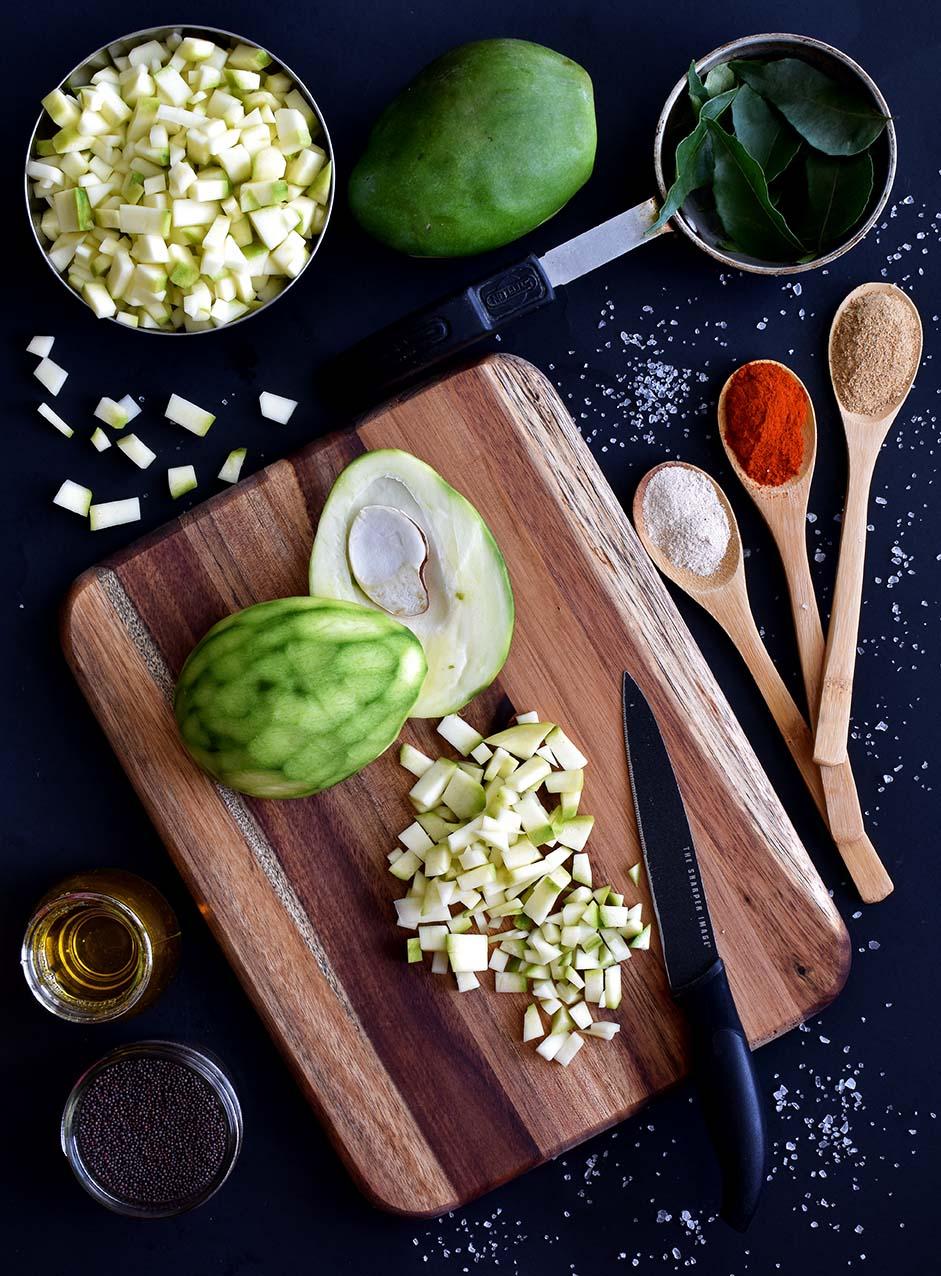
Diversity of Mango Pickle in India
India has a wide variety of pickles. The Indian pickles are well known all over the world for their taste and unique flavor due to the use of unique spice mixes. The taste of mango pickle combines flavors such as tang and spice. In meals like rice, paratha, roti, etc., mango pickle commonly serves an important role as a side dish.
Mango Pickle has the most diversity across all regions of India. Region-wise, the mango varieties, spice mix, edible oil, key ingredients, and methods of preparation change. In the northern region of India, mainly mustard oil is preferred, while in the southern region, groundnut oil & sesame oil are used in the Avakaya Mango Pickle.
Legal Definitions and Specifications
Food Safety and Standards (FSS) Rules (2006) defines pickles prepared from fruits, vegetables, or other edible plant material including mushrooms—free from insect damage or fungal infection, singly or in combination—preserved in salt, acid, sugar, or any combination of the three. The pickle may contain onion, garlic, ginger, sugar, jaggery, edible vegetable oil, green or red chillies, spices, spice extracts/oil, lime juice, vinegar/acetic acid, citric acid, dry fruits, and nuts. It shall be free from copper, mineral acid, alum, synthetic colors, and shall show no sign of fermentation.
The Science of Pickling
Pickling is one of the traditional methods of preservation of fruits and vegetables known to humans. Pickling is the process of preserving food in a high-acidic solution, either by the addition of vinegar or naturally by means of fermentation. Due to high acid concentration, only desirable microorganisms can grow, which also inhibits the growth of undesirable bacteria. High acidity can be achieved through three ways:
- By means of salt
- By means of vinegar
- By means of both
Salty water, sugar water, lemon juice, or vinegar are used as acid brine preparations. Either singly or sometimes in combination, these liquids are poured over vegetables, fruits, meat, or fish, which are then sealed in a clean, moisture-free jar and set aside for several days to ferment.
Fermentation is the process in which the sugar and carbohydrates present in the food are consumed by beneficial bacteria (desirable bacteria), converting that sugar to produce acids, alcohols, and carbon dioxide. Probiotic foods are the result of fermentation, which helps improve human digestion.
India has an incredible variety of pickles and tastes, and the method of pickling varies from region to region, featuring unique flavors mixed with spices such as cumin, mustard seeds, fenugreek, turmeric, and coriander. Indian pickles such as mango (Aam ka achar), lime (Nimbu ka achar), turnip, and cauliflower enjoy popularity all over the world.
Preservatives Used in the Pickling Process
Preservatives are natural or chemical substances added to food products to improve texture, flavor, appearance, and enhance the shelf life of the product. According to FSSAI, preservatives are substances added to food that have the capacity to inhibit or retard the process of fermentation, acidification, and spoilage. They are added intentionally to prevent the growth of spoilage-causing bacteria, yeast, and molds.
Classification of Preservatives:
There are two classes of preservatives:
- Class I: Natural preservatives
- Class II: Chemical preservatives
1. Natural Preservatives
Natural preservatives are compounds mainly derived from plants, plant parts, or naturally occurring substances added to food to prevent or retard deterioration and enhance shelf life. Common salt, vinegar, edible vegetable oil, and spices are examples commonly used in the pickling process. They are non-toxic, easily available, stable, economical, and do not alter the natural taste of the final product.
A. Pickling with Salt
Pickling with salt is mainly carried out by two methods: dry salt and brining. In the dry salt method, salt is seasoned over vegetable pieces. Salt action releases free water from the vegetables, combining with salt to create natural brine through tissue osmosis. In dry salting, approximately 2–3% salt is added and left to stand for about 24 hours. Generally, a 15–25% brine solution is used for processing. Such high salt concentrations inhibit microorganism growth and avoid spoilage.
As per FSSAI Guidelines for pickles in citrus juice or brine:
- Drained weight: Not less than 60 percent
- Sodium Chloride content when packed in brine: Not less than 12 percent
- Acidity as Citric acid when packed in Citrus Juice: Not less than 1.2 percent
B. Pickling with Vinegar
Pickling in vinegar is the quickest method for fruit and vegetable preservation. The acetic acid present in vinegar inhibits microbial growth and spoilage. As per the Prevention of Food Adulteration Act (PFA 1954), vinegar should contain a minimum of 3.37% acetic acid. Vinegar lowers pH, penetrates bacterial cell walls, denatures plasma proteins, and inhibits growth. For best results, the final concentration of acetic acid should not be less than 2 percent.
As per FSSAI guidelines for pickles in vinegar:
- Drained weight: Not less than 60 percent
- Acidity of vinegar as acetic acid: Not less than 2.0 percent
C. Pickling in Oil
The method of pickling in oil is traditionally used across India. Commonly, mustard oil is used for most northern pickles (like mango, cauliflower, and turnip), while groundnut oil and sesame oil are preferred in southern varieties like Avakaya Mango Pickle. Vegetables are completely immersed in edible oil, which acts as a barrier against oxygen and moisture, creating anaerobic conditions that inhibit undesirable bacteria.
As per FSSAI guidelines for pickles in oil:
- Drained weight: Not less than 60 percent
- Fruit and vegetable pieces shall practically remain submerged in oil
D. Preservation by Spices
Spices are homogenous groups of substances obtained from various plant parts including buds, bark, flowers, and seeds. Essential oils present in spices act as antimicrobial agents inhibiting pathogenic and spoilage-causing bacteria while building unique flavor profiles (e.g., curcumin in turmeric, piperine in pepper, eugenol in clove).
2. Chemical Preservatives
As per the FDA (Food and Drug Administration), any chemical added to food to prevent or retard microbial growth, inhibit spoilage, and increase shelf life is known as a Class II preservative. Chemical preservatives help retard yeast and mold growth, though they may alter the natural flavor of ingredients.
- Benzoic Acid (250 ppm max): Benzoic acid and its salts (E210, E211, E212, E213) inhibit mold, yeast, and some bacteria. Commonly used in acidic foods like pickles, fruit drinks, and soft drinks. The maximal permissible limit is 250 ppm.
- Sulphur Dioxide (100 ppm max): Acts as an antioxidant preventing enzymatic browning, preserving visual appeal, and maintaining the natural flavor of ingredients during processing. The maximal permissible limit is 100 ppm.
Why is the Pickling Process Important?
Preservation of fruits and vegetables is achieved mainly through two ways:
- By killing all spoilage-causing (undesirable) microorganisms via heat or other methods and enhancing desirable microorganisms.
- Altering the environment to inhibit organism growth and multiplication.
The first method is generally used for juices and fruit powders. The second method is tailored for pickling, utilizing sufficient quantities of salt, vinegar, lactic acid, and lemon juice—singly or combined—alongside flavor-enhancing spices and edible oils.


 Item Added to cart!